How will the Covid-19 (coronavirus) epidemic in the UK develop?


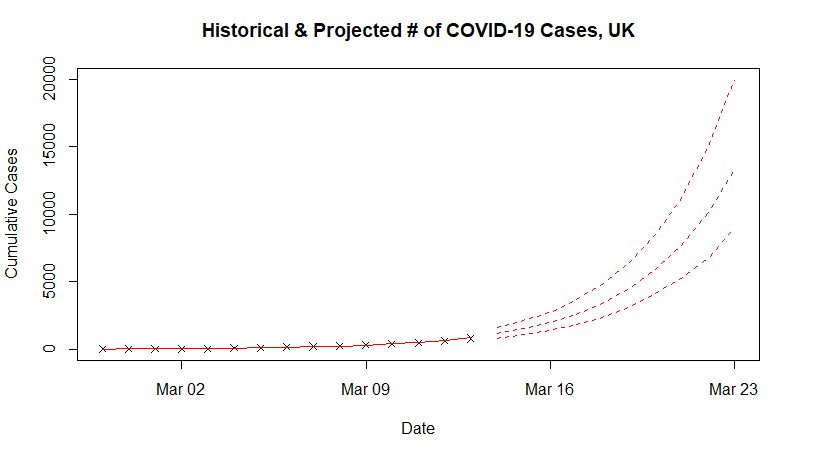
How will the Covid-19 (coronavirus) epidemic in the UK develop? In February 2020, there were sporadic cases across the UK and in March 2020, we saw a more sustained increase in cases. Based on current trends, the total cumulative number of cases of COVID-19 in UK could reach 5,895 (95% CIs: 4,046 to 8,400) in another 7 days.

We have assumed that each day's cases are a fixed proportion of the total cases up to the day before. It is also assumed the rate will not change in the next 7 days, e.g., it is not going to be influenced by new interventions, increased self-isolation and other factors.

To estimate confidence intervals, we used the prediction confidence intervals from the linear regression model (using logarithm of "cumulative number of cases" as response) to perform Monte Carlo simulations to generate samples from the corresponding normal distribution. Subsequently, we applied the reverse transformation (exponential) to the simulated samples and calculated the 95% confidence Intervals.

The results of the model suggest that the NHS could be dealing with large numbers of patients with Covid-19 infection in the next 7-10 days. We will soon know how well prepared we are to deal with Covid-19 infection.

If the number of cases is below predictions, this would imply that control measures and behavioural change are having some impact in keeping numbers down. It could also though reflect changes in the policy for testing people who are suspected cases. We will update chart this regulary if we can get reliable data about the number of Covid-19 cases in the UK and the data is not skewed by the government decision to cut back on community testing.

Azeem Majeed and Mansour Taghavi Azar Sharabiani

Comments

Popular posts from this blog

What is the difference between primordial prevention and primary prevention?

Primordial prevention and primary prevention are both crucial strategies for promoting health, but they operate at different levels. Primordial prevention aims to address the root causes of health problems and improve the wider determinants of health. It focuses on preventing the emergence of risk factors in the first place by tackling the underlying social, economic, and environmental determinants of health. This involves broad, population-wide interventions such as: Policies that promote healthy food choices: Think about initiatives like taxing sugary drinks to discourage unhealthy consumption, or providing subsidies for fruits and vegetables to make them more accessible. Urban planning that prioritises well-being: This could include creating walkable neighborhoods with safe cycling routes, ensuring access to green spaces for recreation and relaxation, and designing communities that foster social connections. Social programs that address inequality: Initiatives aimed at reducing pov...

UK Covid-19 Inquiry - The Importance of a Strong Primary Healthcare System

In my witness statement for Module 10 of the UK Covid-19 Inquiry, I discuss the pandemic's impact through from the perspectives of  primary care and public health, drawing on my extensive experience as a senior academic at Imperial College London and as a practising GP and NHS Public Health Specialist.  I emphasise that the pandemic disproportionately affected people who were clinically vulnerable, the disabled, ethnic minority communities and those living in deprived areas. The pandemic highlighted how structural inequalities, multigenerational housing, and employment in high-risk frontline roles exacerbated health disparities.  My statement also critiques the weakening of public health infrastructure - particularly for the control of infectious diseases - and the lack of integrated health data systems to identify at-risk groups such as the clinically vulnerable. I also advocated for a more robust preventive healthcare model that prioritises community-based primary care ...

Protecting Young People from Meningococcal B Disease: The NHS Targeted Vaccination Programme

Meningococcal group B (MenB) infections are rare but can have devastating consequences. The decision to offer a targeted two-dose vaccination programme to Year 13 students and young people entering university or residential further education reflects concerns about recent outbreaks of meningococcal disease and the higher risk of transmission when large numbers of young adults mix closely for the first time in shared accommodation. The MenB vaccine has a well-established safety record, and evidence from the UK infant immunisation programme has shown substantial reductions in disease among vaccinated children. A targeted programme for those entering higher-risk settings is therefore a reasonable precautionary measure while further evidence is gathered on whether the recent increase in clusters represents a temporary fluctuation in disease patterns or a more sustained change in the epidemiology of MenB infection. The success of the programme will depend on achieving high uptake and ensuri...